

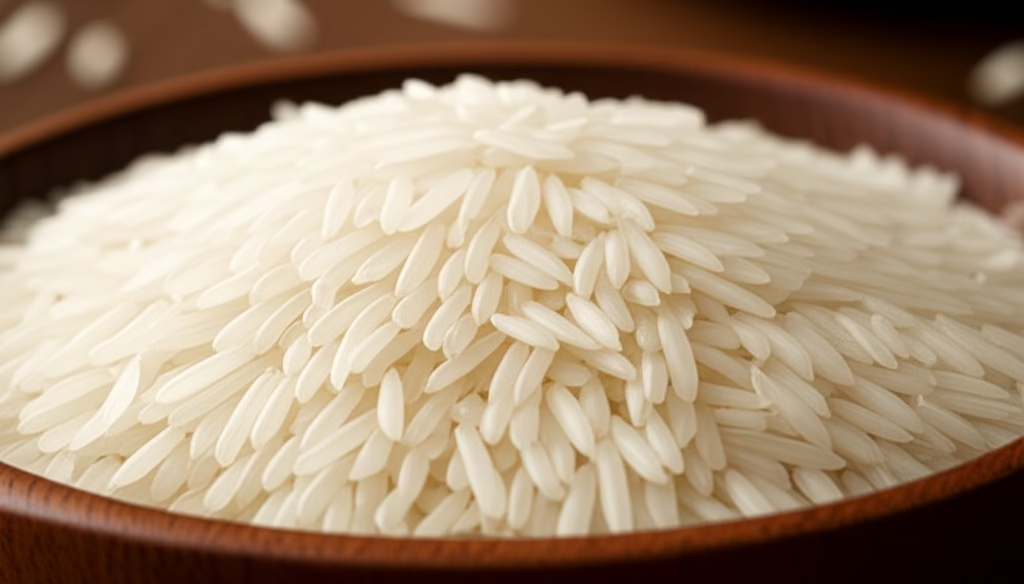
You’ve seen our Basmati Rice cooking time suggestion as 15 to 20 minutes on the stovetop after a 30 minute soak. Now, it’s time to dive a little bit deeper, without putting you to sleep. Let’s begin with a little Basmati Rice introduction!
Basmati Rice Overview
Often referred to as the “Prince of Rice,” Basmati is a long, slender-grained aromatic variety primarily cultivated in the foothills of the Himalayas in India and Pakistan. India holds a dominant 65% share of the global Basmati market. Its hallmark is a distinct, captivating aroma and a flavor profile described as nutty, floral, and subtly spicy. This unique fragrance is attributed to the chemical compound 2-acetyl-1-pyrroline.
Basmati is the quintessential rice for Indian Biryani and Pulao. It is also extensively used in American pilafs, as a side dish for curries, and in desserts like Kheer. Its aromatic quality and separate grains make it ideal for dishes where these characteristics are paramount.
High-quality Basmati rice is often aged for several years; this process serves to dry the grain further, which not only enhances its characteristic flavor but also contributes to a fluffier, more separate texture upon cooking. This aging process is a significant quality differentiator, elevating Basmati beyond simple cultivation and contributing to its premium status. The grains are noted for expanding significantly in length rather than width during cooking.
Basmati Rice Fact Sheet
Below, you can learn more about the Basmati Rice cooking time, culinary applications and a few other interesting details such as rice to water ratio, aroma, texture, origin and more.
| Basmati Rice Aspects | Basmati Rice Details/Facts |
|---|---|
| Origin | Primarily grown in the foothills of the Himalayas in India and Pakistan. |
| Appearance | Long, slender grains that elongate further upon cooking. Typically white, but also available in brown. |
| Aroma | Distinctive, pleasant, and nutty aroma, often described as popcorn-like, due to the presence of 2-acetyl-1-pyrroline. |
| Flavor | Delicate, nutty, and slightly floral taste. |
| Texture | Cooked grains are separate, fluffy, and tender, not sticky. |
| Elongation | Grains can elongate to almost twice their original length when cooked. |
| Aging | Often aged for several months to a year or more, which enhances its aroma, flavor, and cooking qualities. |
| Common Uses | Biryani, pilaf, pulao, as a side dish for curries and stews, and in various Middle Eastern and Indian cuisines. |
| Cooking Time | Typically 15-20 minutes for white Basmati after soaking (soaking for 30 mins is recommended). Brown Basmati takes longer, around 40-45 minutes. |
| Water Ratio | Usually 1 part rice to 1.5-2 parts water, can vary based on cooking method and desired texture. |
| Varieties | Several varieties exist, including Pusa Basmati, Basmati 370, Basmati 385, and Super Basmati. |
| Nutritional Profile (approx. per 1 cup cooked white Basmati) | Calories: ~205, Protein: ~4g, Fat: <1g, Carbohydrates: ~45g, Fiber: <1g. Brown Basmati has higher fiber. |
| Glycemic Index (GI) | Medium GI (around 50-58), which is generally lower than many other white rice varieties. |
| Key Benefit | Its unique aroma, flavor, and fluffy texture make it a premium choice for many dishes. |
Come back soon as we will expand on each rice type as time goes by. For now, enjoy some easy cooking thanks to our Basmati Rice cooking time and details!